
Cities Are Putting Rats on Birth Control. The Company Making the Pill Just Had Its Best Quarter.
The Atlantic says the rat pill has gone mainstream in American cities. SenesTech, the Nasdaq micro cap behind it, just posted record revenue and a 73.6% gross margin, and most of its sales now come from online orders.
This month The Atlantic ran a feature on city rats going on birth control. When a magazine that has been around since 1857 writes about rodent family planning with a straight face, it usually means the idea is no longer a niche experiment. City halls now treat it as a normal tool.
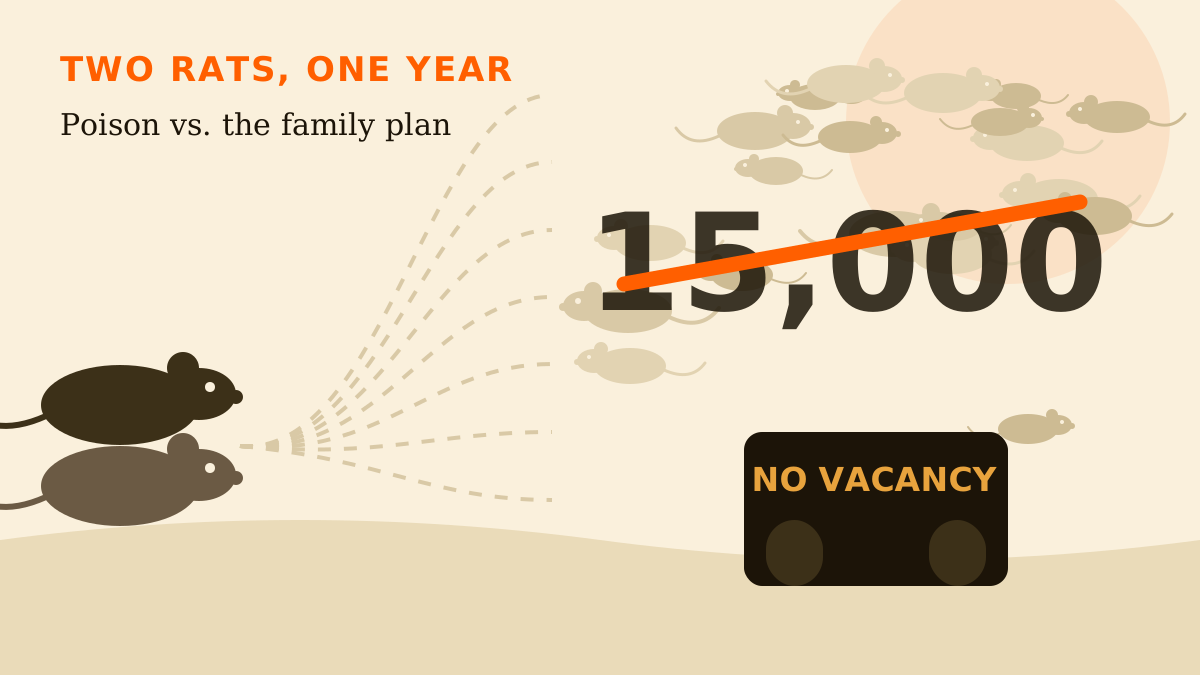
Here is the problem cities are trying to solve. By SenesTech's math, two rats can turn into about 15,000 in a year. The usual answer has been poison. The poison is also turning up in hawks, owls and the family dog. Chicago has been Orkin's rattiest city in America for ten years running. In 2025 it put fertility bait boxes in the alleys of Wicker Park and Bucktown, about 100 of them, and then extended the program to Lincoln Park. The alderman there said rat poison had been confirmed as the cause of death for horned owls in his ward. Baltimore ran a pilot and then expanded it. Swampscott, Massachusetts started one at its fire station after a local advocate found the town was still using the strongest class of anticoagulant poisons.
The bait in those boxes is Evolve, made by SenesTech (Nasdaq: SNES), a Phoenix area company that grew out of University of Arizona fertility research. Evolve is a soft bait built on cottonseed oil. The EPA lists it as a minimum risk pesticide, and it reduces fertility in both male and female rats. The rats don't die in a wall. There are just fewer new ones every cycle. That's why every pilot above gets pitched as the humane option, and it's also the reason cities are willing to try it.
The business side is the part most of the coverage skips. On August 5 SenesTech reported the best quarter in its history. Revenue was $770,000, up 56% from the first quarter and 23% from a year earlier. Gross margin hit a record 73.6%. E-commerce made $511,000 of that, up 206% year over year, and for the first time it passed direct sales to businesses and cities. Amazon alone brought in $349,000 in the first full quarter after SenesTech took over its own storefront. Subscription revenue nearly doubled from the prior quarter. CEO Michael Edell summed it up as record revenue, record gross profit and record gross margin.
In practice that means SenesTech is building two businesses. One is the slow municipal pipeline, where the press coverage comes from. The other is homeowners buying rat birth control online the way they buy dish soap, and that one is now the larger of the two. The company also brought in a new head of sales this summer to push the business and city side, with Chicago as its lead municipal market.
Now the sober part, because somebody has to say it. SenesTech is still small. Net loss for the quarter was $1.8 million, down from $2.1 million in Q1, and it had $5.1 million in cash at the end of June. Fertility control is also slow by design. It works over generations, not over a weekend, and the pilots are measured in blocks, not whole cities. For now it works alongside trapping and sanitation. It doesn't replace them yet.
The desk take: when The Atlantic writes about your product, the idea has gone mainstream. What SenesTech has to show next is that Amazon buyers and city halls keep reordering. Management gets its next chance to make that case at the Lytham Partners Fall 2026 Investor Conference, with a webcast at 2:00 p.m. ET on Tuesday, September 29.